


If your bookings felt a little lighter this year, you weren’t imagining it. Across outdoor recreation, reservations were down in 2026. But here’s the part that surprised everyone, including us: revenue wasn’t.
That “us” is three companies, not just one. We had an idea: bring together a couple of industry partners who see this business from completely different angles, and compare notes on the season that just wrapped. Jessie Stover, our Director of Customer Operations, volunteered to lead the conversation, sitting down with Zeb Smith from Zebulon and Aaron Lieberman from America Outdoors.
Here’s the part that made it worth publishing. Each of us ran our own numbers separately, with different data and different methods, and zero coordination beforehand. We all came back with the exact same story. As Jessie put it on the recording: “We did not do it in a circle, and everything is still pointing to the same thing.“
Fewer bookings, bigger spend
In Flybook’s own numbers: reservations down about 8% year-over-year, but each one worth roughly 7% more. Room bookings actually climbed 4.5%, but guests weren’t paying more for them, so that growth never quite showed up as extra revenue.
Zebulon and America Outdoors saw their own versions of the same pattern: smaller volume, bigger average spend. Three companies, three different vantage points, one conclusion.

Flybook’s matched-day comparison, 2026 vs. 2025: the same calendar stretch in both years, since 2026’s tracked season ran a week longer.
It depended entirely on where you were standing
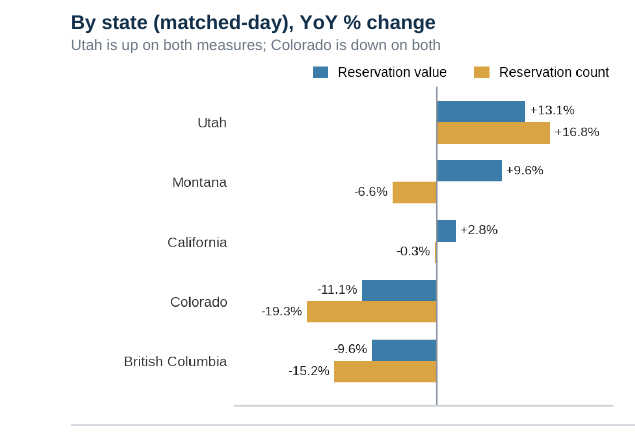
Nothing about this season was uniform. Bookings in Utah were up around 17%. Colorado was down about 19%. Same industry, same summer, opposite results, mostly thanks to water levels, wildfire smoke, and a run of weather that hit some regions and skipped others completely.
Even the weather had its own personality this year. Lightning kept Southeast zipline bookings jumpy. A slow-to-warm spring lingered over the Midwest and Colorado into early summer. Low water combined with wildfire smoke took a real toll on Colorado rafting specifically. One operator contact estimated volume there could be down 40%, though the full numbers are still coming in.
For what it’s worth, Jessie, whose family has run a rafting company in West Virginia for 50 years, had a good reminder: weather has always been part of this business. Her favorite question from guests, “it’s raining, are we still going rafting?” has exactly one answer. YES.
A pattern nobody expected
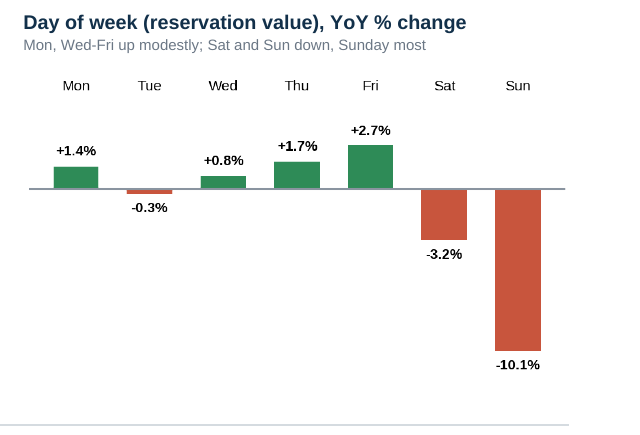
Here’s the moment that genuinely surprised the room. Flybook’s data showed bookings shifting away from weekends. Sundays specifically dropped more than 10% year-over-year. Zebulon hadn’t noticed this in their own numbers until Flybook pointed it out, so they went back and checked. It held up, across a completely different set of operators and reservation systems. Nobody on the call has a confirmed explanation yet. Consider that an open invitation to theorize.
What actually separated a good season from a bad one
The clearest story from this conversation wasn’t really about data. It was about a lodge that burned down.
One operator in Zebulon’s book lost their lodge to a fire last year. Instead of hiding behind a refund policy, they called every affected guest personally and gave people real flexibility. That operator just had one of their best growth years yet.
It’s a good example of the thread running through everything else we talked about: the businesses that held up weren’t the lucky ones. They were the intentional ones.
Heading into 2027
Despite a genuinely tough year in places, operators are feeling good about what’s next. About 4 in 10 expect demand to grow in 2027, and 7 in 10 expect flat or better. That’s a real jump from the quarter who expected growth heading into this season.
As Aaron Lieberman, America Outdoors’ Executive Director, summed it up: the operators who made it through learned to adapt to things they couldn’t control, and they’re carrying real optimism into next season because of it.
What you can actually do about it
This is where the conversation closed, and it’s worth sitting with if this season left you wondering what to change.
Invest in the relationship, not just the next booking.
Jessie made a point that’s easy to forget when you’re chasing this season’s numbers: it costs more to win a new guest than to keep one you already have. The operators who held up this year weren’t always the ones with the flashiest ads, they were often the ones whose past guests kept coming back and telling their friends, season after season. Jessie and her colleague Angel are speaking on exactly this at the America Outdoors Conference this December.
Track profit consistently, not just revenue.
Zeb’s phrase for sloppy tracking was blunt: “junk in, junk out.” If you’re not defining profitability the same way from one year to the next, you can’t actually tell what’s working. Zebulon’s free Basic Training course covers this in detail, and Zeb’s walking through it live at the America Outdoors Conference this December as well.
Zebulon built a free course around exactly this, covering profitability tracking and off-season sales planning, and will be walking through it live at this year’s America Outdoors Conference.
Let lodging do the anchoring.
Flybook’s data backs up something Jessie noticed firsthand: guests commit to a place to stay earlier and more reliably than they commit to a specific activity. If you offer lodging at all, lean on it as the first thing you lock in. The activity booking tends to follow.
Finally, none of this would have been as useful without Zeb and the team at Zebulon, and Aaron and the team at America Outdoors, being part of it. Three companies that don’t compete with each other but clearly care about the same industry, comparing notes in public, is exactly the kind of thing worth doing more of. If you want to meet all three of us in person and keep the conversation going, we’ll all be at the America Outdoors Conference together, December 8 to 11 in Oklahoma City.
Want the full story? Watch the conversation above. It includes the regional weather breakdown, the data behind each company’s numbers, and a few moments that didn’t make it into this recap.